

Watch the full episode on Iowa Starting Line’s YouTube.
YouTube | Instagram | TikTok | Twitter | Bluesky | Threads | LinkedIn
Happy Wednesday, and welcome to Cornhole Champions, Iowa Starting Line's weekly newsletter and podcast, where we throw bags at the state's biggest stories. I'm Zachary Oren Smith.
Things don't always hold up to scrutiny. It's why it's always important to look a little closer. This is unfortunately true about "no tax on tips." It's part of President Donald Trump's tax and spending bill. And it's something Iowa Republicans like US Rep. Mariannette Miller-Meeks are foregrounding as proof of their support for working-class people.
On a stop at Williamsburg's Sun Down Bar and Grill (don't skip out on their broasted chicken), she proudly posed for a picture with her receipt.
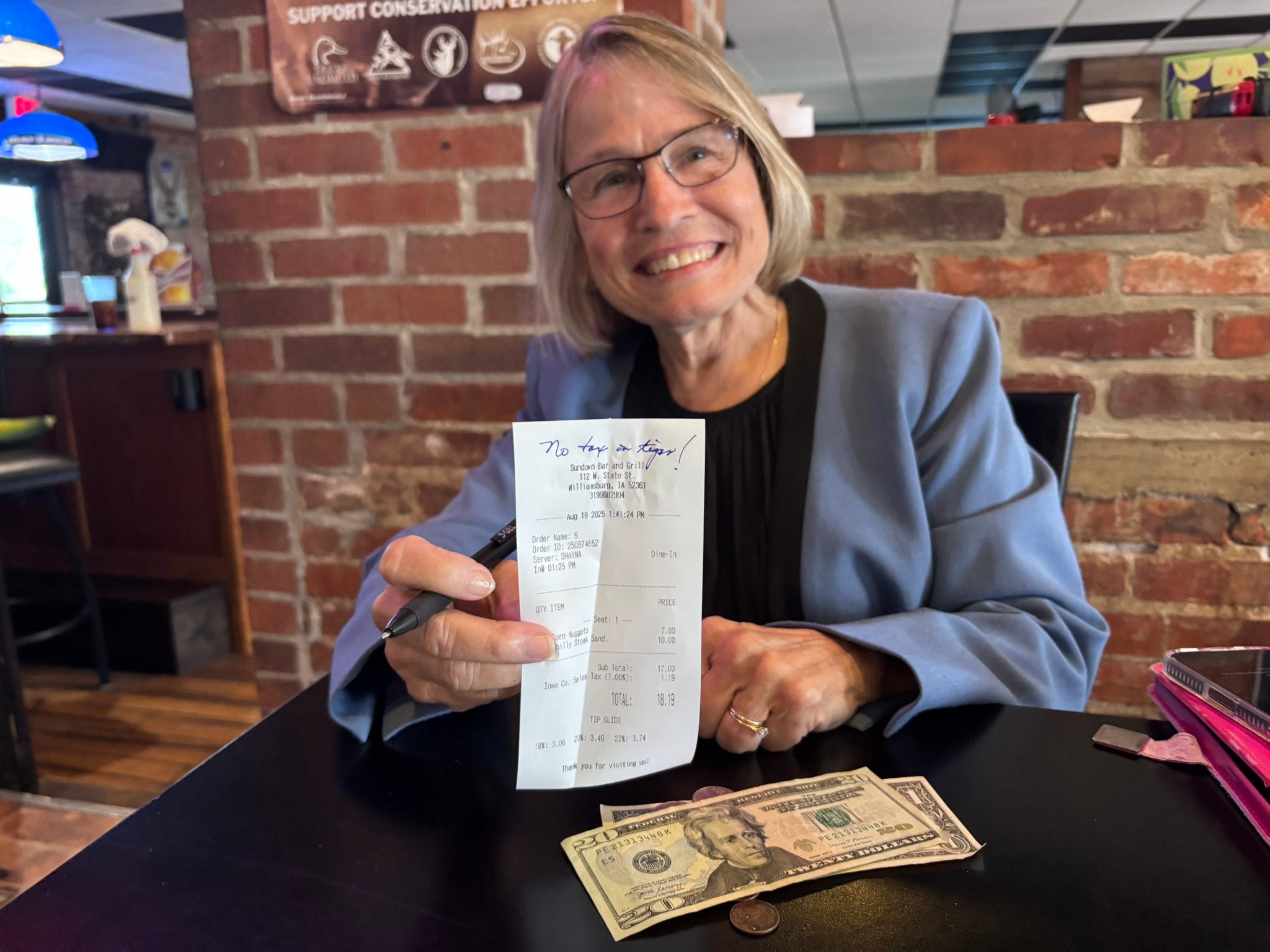
The bill was for $18.19. She left in the frame a twenty-dollar bill, another dollar and some change (is that a penny?). Unless there are some silver dollars hiding in there... we're looking at a small tip. Lucky for me, I'm always looking for teachable moments:
First, what you tip is often what a server makes during their shift. For some reason, restaurants have been allowed to unload the wage burden from themselves and onto customers. It allows them to pay $2.13 an hour, the so-called "tipped minimum wage" (vs. the $7.25 minimum wage--which ITSELF hasn't been raised since 2009). If you are posing as the server's champion and you'd describe the level of service as "wonderful," you should be tipping 20%. In this case $3.46, but help a server out: Round up.
Second, let's talk about how the "Big, Beautiful Bill" actually impacts taxation on tips. The tax break only applies to the first $25,000 in tip income. Which sounds like a lot, but it requires you to report all your tips to your manager (which every server does, every shift). The IRS wants to make sure you're paying taxes on everything above that $25,000 threshold. And crucially, you still pay payroll taxes on every dollar—Social Security and Medicare aren't going anywhere.
Here's the kicker: about 36% of tipped workers already don't pay federal income taxes thanks to the standard deduction. So for more than a third of the people this policy is supposed to help, it changes nothing. The average worker who does benefit saves about $1,700 a year—not nothing, but hardly transformative for someone making poverty wages.

The policy also comes with some strange limitations. If your restaurant automatically adds gratuity to large parties, that doesn't count as a "tip" under the law. If you're a rideshare driver getting tipped through an app, you're out of luck—contractors don't qualify. And the whole thing expires in 2028, meaning Congress will need to renew it or watch it disappear.
But here's what really undermines the "helping workers" narrative: the same bill that creates this modest tax break also cuts SNAP food assistance and Medicaid benefits. So while tipped workers might save a few hundred dollars on their tax bill, many could lose out on support for food and healthcare.
Finally, something doesn't have to be uniformly good to help. And that's kind of how I think about taking the tax off of tips. The more precarious your rung is in the economy, the more support there should be for stabilizing your household and helping you climb higher. By taking the federal tax off the first $25,000 in tipped income, that is a material step in the right direction.
But unfortunately, it's being used by bad tippers to launder a bill that destabilizes local hospitals, will knock 86,000 Iowans off their insurance, and kneecaps the high-paying jobs the state's renewable energy sector was creating. All so that we can add an additional $4.1 trillion to the national debt over the next decade and so the richest 10% of Americans will see their income increase by $13,600 from tax cuts.
At least when Miller-Meeks leaves a bad tip, she's only shorting them a few bucks. It's the rest of the bill that's going to cost us trillions.
In this newsletter, catch up on this week's entry in The Hot Spot: Investigating Cancer in Iowa. We asked readers to share their cancer stories. And they offered some really gripping glimpses into the cancer crisis.
But first...
James 4 Iowa - State Rep. Lindsay James of Dubuque officially launched her campaign for Iowa's 2nd Congressional District, setting up a Democratic primary challenge to take on Rep. Ashley Hinson in 2026. James brings seven years of legislative experience and a compelling personal story about fighting for insulin access after meeting a constituent forced to choose between rent and life-saving medication. “ I had this moment in the Legislature where I was looking around and I thought to myself, Where are the advocates for everyday Iowans?” she told me. “Where are the people who are fighting for my constituents who are struggling to afford insulin and rent?” Read more about her announcement here.
Catelin Drey's special sprint - With just a week until the August 26th special election, Democrat Catelin Drey is knocking doors across Sioux City's Senate District 1. The founder of "Moms for Iowa" started her political activism after Uvalde, making phone calls to legislators about gun violence prevention. Now she's hoping that grassroots energy can flip a seat in western Iowa, an area that hasn't seen many Democratic victories lately. Early voting has already begun.
Teachers vs. business logic - Veteran educator Skyler Snickberg penned a powerful piece in the Des Moines Register pushing back against Iowa DOGE's proposal for performance-based teacher pay. His argument? "Students aren't products that can be recalled if they don't meet standards." The proposal would tie teacher compensation to test scores, but as Snickberg wrote, teachers don't get to pick and choose their students like private schools do. They serve everyone, especially those who need the most help.
And now for our feature. A few stories from the frontlines of our cancer problem...

Facing cancer in Iowa: Patients share their stories
Cancer in Iowa isn’t just about treatment—it’s about surviving the system, asking why it happened, and living with the aftermath. Five Iowans share their stories.
Gano Whetstone settled into the infusion chair at Des Moines’ Mission Cancer + Blood and asked for her usual: black coffee and a warm blanket. On treatment days, she takes the paratransit bus to the hospital, arriving early to wait in the lobby until it's her time.
The 80-year-old retired teacher has done this routine every three weeks for nearly a year now. The nurse wheels over a machine and hooks it up to Whetstone’s infusion port—a device surgically installed in her shoulder that allows her to receive her slow drip of Herceptin on treatment days without requiring the poke of a needle.
"I don't feel anything," she says, watching the IV work. "I just sit here, drink my coffee, and watch TV."
It sounds mundane, but Whetstone said catching the cancer feels miraculous.
Last July during a routine mammogram, doctors found what was likely a cancerous tumor in her breast tissue.
"I just looked at the floor,” she said, as the doctor delivered the news.
For the last year, Whetstone has been navigating the aftermath of that moment—a journey familiar to many cancer patients across Iowa who face a complex matrix of decisions about their care.

This week on The Hot Spot: Investigating Cancer in Iowa, we‘re sharing some of those stories. Cancer in Iowa isn’t just about receiving a diagnosis and figuring out the right treatment. It’s navigating hurdles related to insurance and care; wondering what might have caused the disease in the first place; and living with the physical and emotional aftermath long after the last scan.
Whetstone’s doctor offered her three options: radiation, chemotherapy, and immunotherapy. When her mother went through cancer treatment decades earlier, she remembered watching her struggle with the side effects of chemo. Seeing her mother lose her hair was a memory that stuck with her.
"You never really understand a lot of it when they're explaining it to you," Whetstone said.
Instead of chemotherapy or radiation, she decided to go with immunotherapy because it had more side effects she was willing to manage. Keeping her hair was a bonus.
Her doctor prescribed a course of Herceptin. It’s sometimes used to treat breast and stomach cancers by blocking a particular protein that promotes cancer cell growth. The drug is estimated to have saved more than 3 million lives since its introduction in 1998. The rub: Herceptin—a brand name for the chemical trastuzumab—is expensive.
Whetstone said each infusion treatment costs around $5,000, a fortune on a fixed income. Even with Medicare, Whetstone couldn't afford the mounting costs. She applied for an elderly waiver to get Medicaid coverage, then hit another wall when the surgeon's office initially said they wouldn't take her insurance. Three phone calls and three and a half weeks of waiting later, she finally got approval for the surgery.
"If [the insurance companies] make mistakes and stuff, you know, then you're stuck waiting," she said. "And you can't have your surgery or treatment because they have to get the insurance straightened out."
Whetstone lives in an apartment complex with a number of other elderly Iowans. When they meet once a week in the common area to talk about politics or the news, she said she wonders how her neighbors would fare navigating the system.
"There's no way they can do this themselves," she said. (She herself had help thanks to a service coordinator from Broadlawns Medical Center.)
As the machine beeps to signal her treatment is finished, Whetstone cautiously reflected on the road ahead. In two weeks, she'll have her final infusion. And come September, a mammogram will determine if she's in remission.
“They said, it looks good, and I feel really confident that it'll be okay,” Whetstone said. “But the thing is, I did this before.”
Before starting her first dose of Herceptin, surgeons operated to remove the tumor in Whetstone’s breast. But within weeks,the cancer came back, and she needed a mastectomy. Now, with her immunotherapy complete, she hopes next month’s mammogram brings good news.
“ I don't wanna get false hope in here,” Whetstone said, “because I did last time. A lot of times I don’t even think about it. I just … go to the activities of my building and, you know, meet people and do things.”
Read all the stories at Iowa Starting Line.

Question for you
Here's what's bugging me about the tip thing---yes, I'm still stuck on it. I keep thinking about raising the minimum wage, increasing the child tax credit, expanding the housing voucher system... all things that we could be spending our time on if our goal is to help out the work class. Which leads me to my question:
If you had the power, what's one policy that you think would start helping people out tomorrow? Blue sky. Everythings on the table. What would it be?
Send your answers to zach@iowastartingline.com. I might read your answer on the show.
Before you go
Support this work by doing these three things:
Subscribe to Cornhole Champions on YouTube and like our videos to improve their reach.
Join the game by signing up for my Substack newsletter and get these episodes straight to your email on Wednesday mornings.
Sign up for Iowa Starting Line's flagship newsletter.
Cornhole Champions is a weekly podcast powered by Iowa Starting Line with music by Avery Mossman and show art by Desirée Tapia. We are a proud member of the Iowa Writers Collaborative.
Your friendly neighborhood reporter,
Zachary Oren Smith
Political correspondent
Iowa Starting Line


