

Watch the full episode on Iowa Starting Line’s YouTube.
YouTube | Instagram | TikTok | Twitter | Bluesky | Threads | LinkedIn
Happy Wednesday, and welcome to Cornhole Champions. Iowa Starting Line's weekly newsletter and podcast where we throw bags at the state's biggest stories. I'm Zachary Oren Smith.
It's an off-year, but the news cycle hasn't been acting like it. On the show today: Another candidate raised his hand to take on US Sen. Joni Ernst. My colleague Amie Rivers has new reporting on how funding cuts will gut cancer research. And I have some reporting looking at why we shouldn't be surprised to see an outgoing Iowa Republican once again taking a swing at hundreds of thousands of Iowans' retirement plans.
Remember, we're able to assemble these missives because of your support. If you haven't become a supporter, now's a great time. If now's not a great time, help us get this work out there by sharing it with your friends. It makes a difference.
Before the big show, here are some stories to keep in mind...
Turek 4 Iowa - State Rep. Josh Turek of Council Bluffs launched his bid for US Senate Tuesday morning. It's been an open secret that he would launch in August, a secret the Register confirmed. As part of his launch, he spoke with me for the podcast about his story, his work in the Legislature, and why he's optimistic about Democrats' chances in 2026.
Research cuts kill - As Iowa faces the nation's worst cancer crisis, federal funding cuts are shuttering labs and canceling promising studies. The NIH has slashed over $33 million in research funding at the University of Iowa alone, with only 4% of new cancer research proposals getting funded. Medical school student Claire Brown of Iowa City said she’s worried about the impact that it will have on the future of the medical profession.
Merit pay returns - Gov. Kim Reynolds's DOGE task force is recycling a failed idea of merit pay for teachers, despite Iowa's repeated unsuccessful flirtations with the concept. In Bleeding Heartland this week, Randy Richardson and Bruce Lear detail how Iowa has tried merit pay schemes multiple times since the 1980s—all ending in failure. The plans created competition instead of cooperation among teachers, relied on flawed standardized test measures, and administrators found little variation in teacher performance when pay was tied to evaluations. But unlike previous attempts when teachers had collective bargaining rights, any new plan could be imposed without educator input since Republicans stripped those rights in 2017.
And while we've got DOGE on the mind, let's take a look at another one of its recommendations...
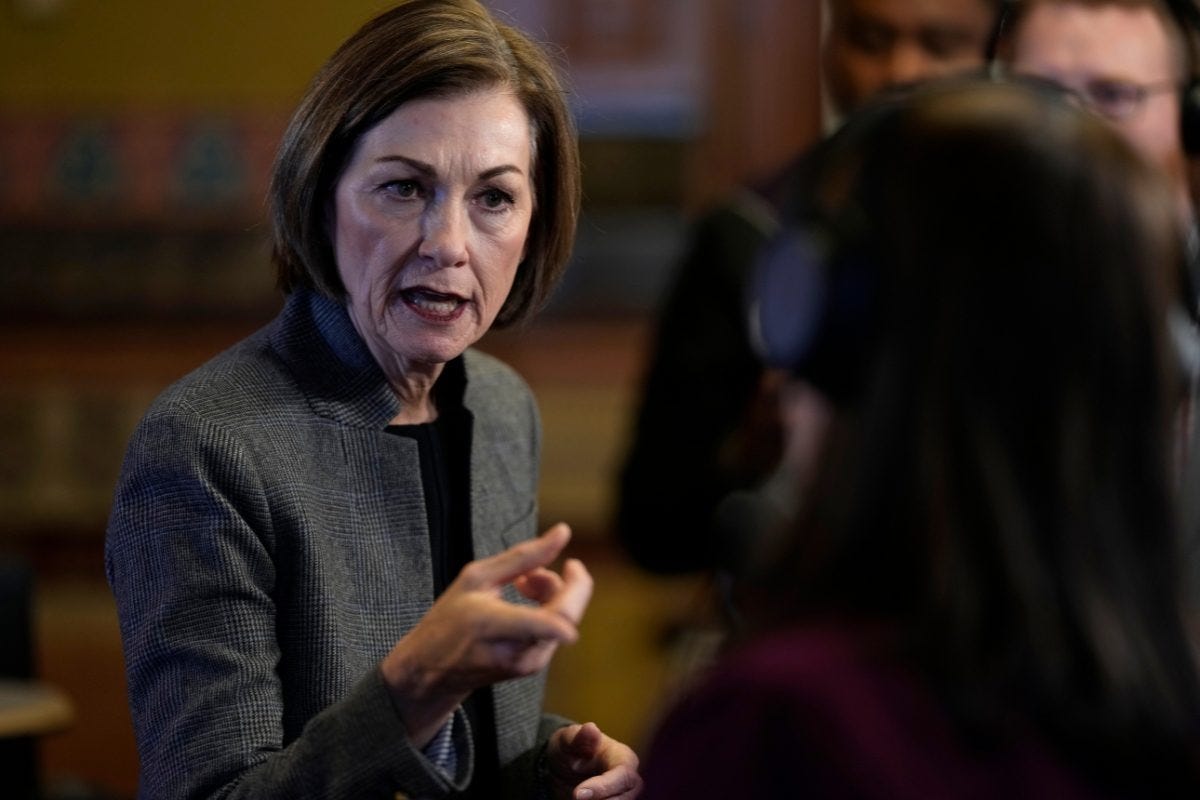
[Iowa Gov. Kim Reynolds appointed a board of wealthy Iowans to recommend ways of making state government more efficient. Pictured, Reynolds speaks during a news conference, Wednesday, Jan. 31, 2024, at the Statehouse in Des Moines, Iowa. (AP Photo/Charlie Neibergall)]
Iowa DOGE targets retirement pensions for teachers, law enforcement
A task force appointed by Gov. Kim Reynolds recommended eliminating the state pension system for new employees and replacing it with a 401(k)-style plan. Iowa DOGE's proposal has sparked fierce, bipartisan opposition.
Governor Kim Reynolds promised in 2018 she’d “protect and defend” Iowa’s public employee retirement program, IPERS. Approaching her final year as governor, her administration is reaching once again for this third rail of Iowa politics, all in the name of so-called government efficiency.
When she chartered it earlier this year, Reynolds said Iowa DOGE—a task force based on the federal DOGE headed by Elon Musk—would make recommendations to further her administration’s efforts to make government more efficient. The board has been criticized for only including Republican ex-officio members.
During a meeting last Wednesday in Des Moines, the task force met to discuss the recommendations they plan to submit to Reynolds and the Legislature by a Sept. 29 deadline. They supplied 45 recommendations, including tying teacher pay to student performance and a "red tape hotline" for reporting bureaucratic problems.
Iowa DOGE also floated a recommendation to replace IPERS for new state employees with a 401(k)-style retirement plan. The proposal would apply to newly hired employees, not current workers who've already been paying in.
IPERS is the state’s largest public retirement system, affecting over 414,000 public workers, including teachers, police officers, and firefighters.
“Currently, the state is contributing nearly 70% to an employee’s retirement plan; where the employee is contributing only 30%. In the private sector, these percentages would almost be the opposite,” Terry Lutz of McClure Engineering Co. told the board. He called IPERS a creator of "huge liabilities for our state."
Pensions, often called defined benefit plans, are employer-sponsored retirement plans providing a guaranteed stream of income and therefore stability for retirees. By comparison, defined contribution plans provide a savings account where the final payout depends on contributions. Where pension systems shift investment risk to employers, defined contribution systems, like 401(k)s, shift that risk onto employees.
Lutz was among the 13 business leaders Reynolds named to the task force representing large Iowa employers like Fareway, Principal Financial Group, and Well Enterprises. These wealthy members of Reynolds’ inaugural Iowa DOGE task force said the change was aimed at reducing liability for the state.
However, even when accounting for benefits, public-sector workers make 14.5% less than their counterparts in the private sector nationwide. Pension plans like IPERS help make up that gap, allowing government jobs to compete for qualified workers.
While seen as a liability by Iowa DOGE, IPERS is among the most stable pension plans in the country. A common measure for a pension’s financial health is its funded ratio; the value of the plan's assets divided by its liabilities. According to an Equable analysis. Iowa’s funded ratio, 91.6% in 2024, was the 11th highest in the country. When IPERS’ quarterly investment board met in December, its CEO celebrated its increased financial stability over the years.
“Because of superior management of its investment portfolio and sufficient contributions from members, IPERS is growing its funded ratio and shrinking its unfunded liability more quickly than anticipated,” IPERS CEO Greg Samorajski said.
Reynolds administration returns to IPERS
Years before Iowa DOGE was a glimmer in the governor's eye, Iowa Republicans explored changing how IPERS works.
In 2017, then-State Sen. Brad Zaun started the conversation with a bill to study moving newly hired Iowa public employees into a defined contribution 401(k)-style retirement system, a massive change to the benefit and the way it’s administered by the state.
On his way out the door that year, former Gov. Terry Branstad announced a study of IPERS, but neglected to establish the task force before departing to become President Donald Trump’s ambassador to China. Nevertheless, things were already moving in the Senate.
Sen. Charles Schneider, R-Des Moines, led an IPERS study committee working with the Reason Foundation, a Libertarian think tank that opposes pensions. While Schneider told the Des Moines Register that no decisions were made, Reason had published a handbook with options for replacing a pension with a 401(k) style.
"I support his (Schneider’s) efforts in doing that," Reynolds said.
The issue became a flashpoint in her 2018 reelection campaign. On a stop in Jefferson, Reynolds called it a scare tactic by Democrats, The Green County News reported.
“They (the legislators) are not going to do anything that will impact your IPERS today, tomorrow, or into the future. It is not going to happen,” Reynolds said.
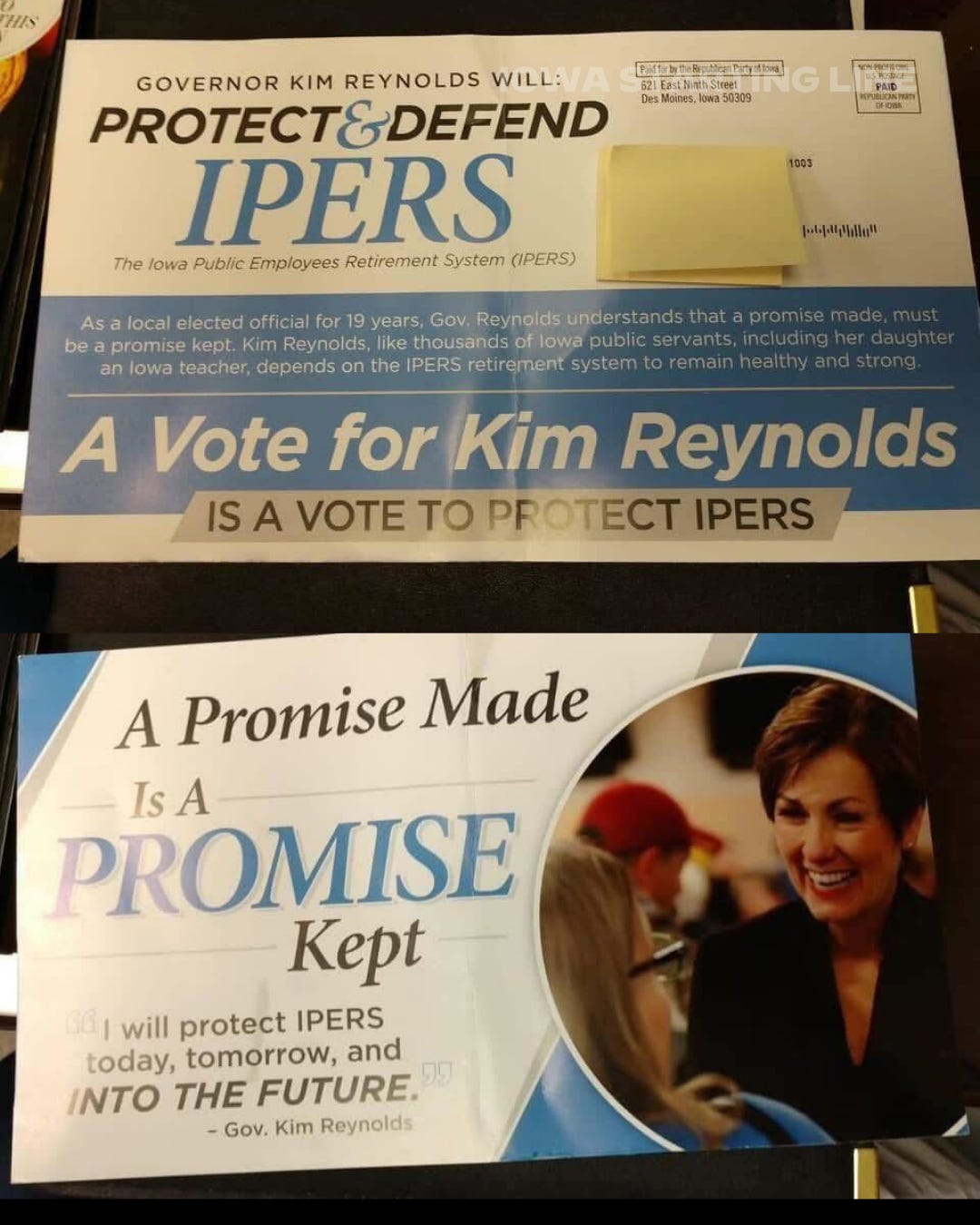
Many Iowans received mailers echoing this suddenly full-throated support for a program that one in ten Iowans have a stake in.
Now, Reynolds’ hand-picked task force appears to be recommending she go back on that promise.
Labor unions, legislators come out against IPERS changes
Iowa DOGE’s proposal was met with severe opposition from groups that represent the affected employees. In a statement, Iowa State Education Association President Joshua Brown said Lutz and the rest of the board were “out-of-touch.”
“Their recommendation to ‘save’ taxpayer money on the backs of public employees is not just an outrageous and unimaginative attempt to distract from future revenue challenges, but also a deeply concerning one,” Brown said. “It has the potential to harm every community in Iowa. IPERS is not broken; rather, it is a model across the country, and their idea is a solution in search of a problem.”
In a social media post, the Iowa Federation of Labor AFL-CIO said, “If Governor Kim Reynolds was actually sincere about making government work better, she’d assemble a task force of public employees, not business executives or pay-to-play donors for advice. Hands off IPERS.”
Democrats joined in the pile-on Iowa DOGE's recommendation, with party Chair Rita Hart saying: “Iowa’s public employees keep our streets safe, our children educated, and our communities vibrant. They deserve a strong pension system like the one they currently have.”
Rob Sand, a Democrat running for governor in 2026, said weakening IPERS only stops people from taking public service jobs, leaving the public worse off.
“Police officers, firefighters, teachers, plow drivers, and more paid into IPERS and should be thanked for their service. They take salaries lower than typical private sector salaries, some because of the promise of IPERS,” Sand said. “This proposal could result in reductions of retirement benefits that these workers have already paid into for years.”
Some Iowa Republicans also oppose the recommendation. State Reps. Ray Sorensen of Greenfield, Ann Meyers of Fort Dodge, and Jason Gearhart of Strawberry Point all made posts to social media saying they’d heard from constituents and didn’t support the recommendation.
State Rep. Brian Lohse of Bondurant told Iowa Starting Line he doesn’t believe there’s support within the Iowa House for changing IPERS in the 2026 Iowa Legislative Session. He said Iowa Republicans already made a number of changes to state government—reduced cabinet level entities, boards, and commissions—and many of those reductions needed to “marinate” for longer before more changes are made.
“We shouldn't shy away from conversations about what’s a better outcome, but if we start down that road, it’s going to have to be with some extremely knowledgeable experts about how any changes affect our current beneficiaries,” Lohse said. “Right now, IPERS is run so well and everyone has gotten used to it. It’s hard to envision a change that would be beneficial.”
Members of the Iowa DOGE:
Emily Schmitt (Task Force Chair), Sukup Manufacturing Co.
Nick Bowdish, Elite Octane
Brianne Schulte, Vermeer
Adam Keune, University of Iowa Pappajohn Entrepreneurial Center
Craig Dozark, Crawford County Board of Supervisors
Terry Lutz, McClure Engineering
Beth Tinsman, Twin State Technical Services
Kathy Kay, Principal Financial Group
Ryan Schaap, Well Enterprises
David Spalding, Iowa State University College of Business
Reynolds Cramer, Fareway
Joe Murphy, Iowa Business Council
Mark Campbell, Former Webster County Supervisor
Hans Wilz (ex-Officio Member), Iowa House of Representatives
Dan Dawson (ex-Officio Member), Iowa Senate
Question for you
Here's what I keep thinking about: if you're a 22-year-old considering whether to become a teacher, police officer, or firefighter in Iowa, you're weighing a lot of choices. IPERS has been a great reason to pick one of these difficult, often thankless jobs. Meanwhile, these are the exact jobs Iowa desperately needs filled. We have teacher shortages, nursing shortages and an aging workforce across state government. So here's my question:
What would it take to make public service attractive to young Iowans if we strip away one of its main benefits?
I'm genuinely curious how you think this plays out. If you're a public employee—or thinking about becoming one—how does this change your calculation? And if you're not, do you think we should be making it harder or easier for people to choose careers serving the public?
Before you go
Support this work by doing these four things:
Subscribe to Cornhole Champions on YouTube and like our videos to improve their reach.
Join the game by signing up for my Substack newsletter and get these episodes straight to your email on Wednesday mornings.
Sign up for Iowa Starting Line's flagship newsletter.
Cornhole Champions is a weekly podcast powered by Iowa Starting Line. It’s produced by me and edited by Rebecca Steinberg. Our music is by Avery Mossman and show art by Desirée Tapia. We are a proud member of the Iowa Writers Collaborative.
Your friendly neighborhood reporter,
Zachary Oren Smith
Political correspondent
Iowa Starting Line


