

Watch the full episode on Iowa Starting Line’s YouTube.
YouTube | Instagram | TikTok | Twitter | Bluesky | Threads | LinkedIn
Happy Wednesday. I'm Zachary Oren Smith, and welcome back to Cornhole Champions, a weekly podcast where we throw bags at the state’s biggest stories.
Today on the show, we dig into the upcoming city-school election cycle, why Iowa Gov. Kim Reynolds wants to withhold emails from the public, and I unveil my most controversial take yet. But first…
One week ago, conservative activist Charlie Kirk was shot on a college campus in Utah. The scene was a familiar one to people who spend too much time in the scroll.
A crowd of rowdy college students huddled around an EZ-Up tent. Kirk was standing there, mic in hand, prepared to deflect whatever criticism a college student brought forth.
It’s a format that I’ve seen do numbers. Whether Kirk makes mincemeat of them or the student gets Kirk stumbling, it’s the kind of thing that people like me, hoovering up content, can’t get enough of. I’m sure I wasn’t the only one who came across the snuff film last Wednesday while scrolling. I wish I hadn’t.
My feelings on it haven’t changed much since I spoke about it last Thursday. I’m still heavy from seeing more violence in my country: the college in Utah, the high school in Colorado, and the encampment in Minneapolis. I’m still cold from the glee I saw from folks I share values with. I don’t think anyone can hate gun violence the way I do and have anything but a heavy heart in this moment.
We lose everything this way. And I think the lessons we learn from it matter. We still have little to explain what motivated the 22-year-old shooter. Yet that didn’t stop folks from grabbing onto the details that best validated the narrative needed. And least for the American Right, that’s of coming conflict.
“War is coming,” wrote one user on pro-Trump message board The Donald.
I wasn’t surprised to find Iowa Republicans going to the mat to cancel teachers and professors over what they said or what they shared about Kirk’s murder. I wasn’t surprised to find an embattled representative clinging to the backlash, hoping to score some points. I suppose I was a little surprised when I saw them go after the Iowa National Guard for the crime of having other priorities that day.
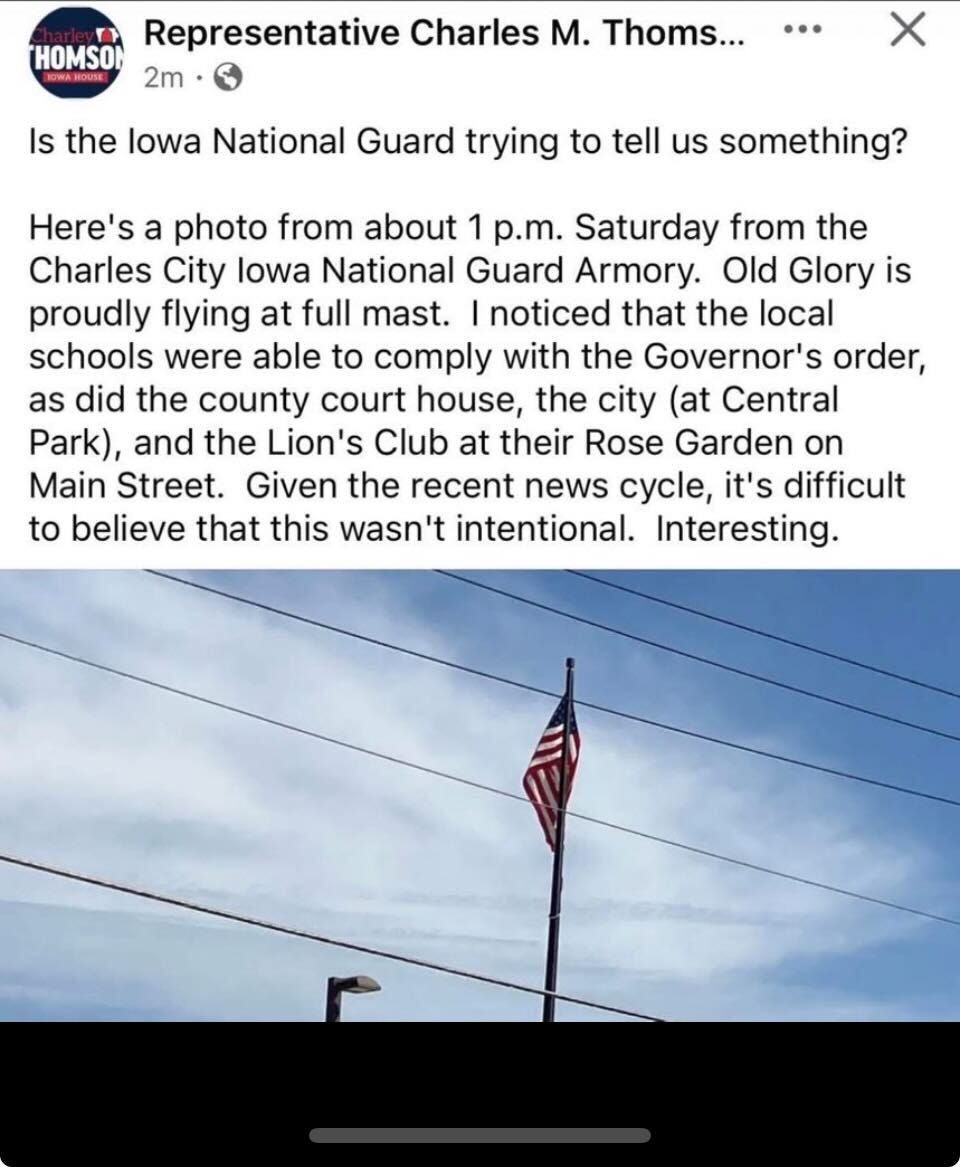
A week later, I’m left wondering whether in my lifetime I’ll see a normal politic. One focused on ordinary things like ending suffering for my neighbors. I’m wondering whether we’ll find the moral spine to feed kids in schools, to give people shelter, and yes, to end gun violence.
There’s a bit from Hannah Arendt’s On Violence (1970) that I keep returning to:
(W)e can control the most complicated processes with a precision that makes trips to the moon less dangerous than ordinary weekend excursions, but the allegedly "greatest power on earth" is helpless to end a war, clearly disastrous for all concerned, in one of the earth's smallest countries (Vietnam). It is as though we have fallen under a fairyland spell which permits us to do the "impossible" on the condition that we lose the capacity of doing the possible, to achieve fantastically extraordinary feats on the condition of no longer being able to attend properly to our everyday needs.
We’re a long way from everyday needs.
Food for thought
Good writing zigs while others are zagging. Or at least that’s what I like reading. As I’ve been thinking about Kirk’s assassination, there were a few pieces I read that stood out as morally clear and thoughtful. Food for thought?
John Ganz from Unpopular Front writes about the paradox between safety and the constitutional rights we enjoy. He argues the conditions that free us from political violence are incompatible with liberty. And that’s exhausting:
We’ll see if this is truly the turning point people seem to think it is. With some weariness, I ask, “What’s going to change exactly? America will become a violent country filled with guns and inflammatory rhetoric? The power of the state will be used without the restraint of the law or rights to attack its enemies?” We’re there already. The true disaster would be to use this to end or injure free political life in this country.
I remain a big reader of Jamelle Bouie—despite all my issues with The New York Times—and so when I saw he was thinking through Kirk, I had to read. He writes that the man eulogized as a paragon of free speech probably has his greatest legacy in “MaCarthyite” watchlists.
It is sometimes considered gauche, in the world of American political commentary, to give words the weight of their meaning. As this thinking goes, there might be real belief, somewhere, in the provocations of our pundits, but much of it is just performance, and it doesn’t seem fair to condemn someone for the skill of putting on a good show.
But Kirk was not just putting on a show. He was a dedicated proponent of a specific political program. He was a champion for an authoritarian politics that backed the repression of opponents and made light of violence against them. And you can see Kirk’s influence everywhere in the Trump administration, from its efforts to strip legal recognition from transgender Americans to its anti-diversity purge of the federal government.
Many—several of whom are neighbors—want to see him as a martyr of conservatism. Backlash has been tremendous for those of us who have troubled the waters of Kirk’s legacy. One of the ways people have approached this is by listing the offense. I think Erin Reed did a good job in the newsletter last week. The conclusion:
His model of politics was not dialogue, but trolling: hopping from campus to campus to bait students, churn out sound bites, and spread hate. And his rhetoric was not debate—it was violent, dehumanizing, and designed to put targets on people’s backs.
Ben Burgis and Meagan Day wrote for Jacobin that the attack is not just a tragedy. It’s a disaster for the future of building a broader left through debate and inquiry. I thought explanation of some of their primary principles was interesting in light of the assassination:
The fundamental premise of left politics is that ordinary people are capable of self-government, at their workplaces and in society as a whole. That goal is only a coherent one if we trust our fellow citizens to be exposed to every point of view, even the worst ones, and to make up their own minds. And our democratic goals can only be achieved by democratic means. We seek to overturn deeply entrenched structures of wealth and power. There’s no realistic way to do that except by winning over the vast majority of the population to our side.
As Burgis and Day conclude their essay, “there is nothing to celebrate here. Indeed, there is much to fear.”
Before you go
Support this work by doing these four things:
Subscribe to Cornhole Champions on YouTube and like our videos to improve their reach.
Join the game by signing up for my Substack newsletter and get these episodes straight to your email on Wednesday mornings.
Sign up for Iowa Starting Line's flagship newsletter.
Cornhole Champions is a weekly podcast powered by Iowa Starting Line. It’s produced by me and edited by Rebecca Steinberg. Our music is by Avery Mossman and show art by Desirée Tapia. We are a proud member of the Iowa Writers Collaborative.
Your friendly neighborhood reporter,
Zachary Oren Smith
Political correspondent
Iowa Starting Line


